


Get a free ebook when you subscribe!
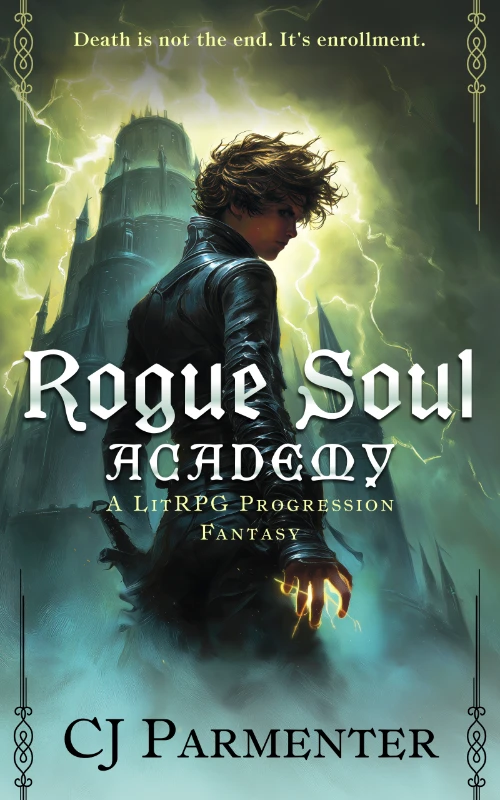
The Obsidian Codex - Rogue Soul Academy

About CJ

Since reading Lloyd Alexander’s Book of Three as a kid, author CJ Parmenter has been a fan of all things sword & sorcery.

He loves wandering lost in worlds filled with reluctant heroes, diabolical magic, jealous dragons, and bizarre mechanisms festooned with cogs and whirling armillary spheres. He is now channeling that passion into the world of LitRPG with his upcoming nine-book saga, Rogue Soul Academy.

More about

CJ Parmenter

Frequently Asked Questions

Not at all. LitRPG stands for Literary Role-Playing Game—it’s a fantasy subgenre where the characters exist inside a world governed by game-like rules. Think stats, skills, and leveling up, but woven into a real story with real heart and real consequences.

If you’ve ever played a video game RPG and thought, I wish this story were deeper, or if you’ve read epic fantasy and thought, I wish I could see the numbers go up, this is where those two worlds collide and explode in a shower of blinding sparks.

Rogue Soul Academy is designed so the system mechanics enhance the story rather than replace it. You don’t need to know what a d20 is. You don’t need to have played Dungeons & Dragons. If you can root for an underdog, you’re qualified.

A: No. AI is a useful tool for research, brainstorming, and refining rough prose, but it doesn’t create my stories.

I write every chapter from a detailed blueprint I type or dictate myself: every plot beat, setting, line of dialogue, internal thought, curse word, and the System’s anachronistic snark. From there, I use AI the way another author might use a critique partner, to make sure every scene lands, push back on the weakest beats, and check for consistency against the world’s mechanics and lore.

AI also solves a real problem for me personally. I have severe dyscalculia, a learning disability that makes mathematical reasoning genuinely difficult. LitRPG is a genre built on numbers. Without AI to validate the math behind my progression systems, I could not write in this genre that I’ve come to love so much.

Aethon Books, a top LitRPG publisher, put it well: “Using A.I. as a tool to aid with the process of writing is exciting. It’s the future. Having it aid in self-editing, research, etc. can help writers get the words out of their heads faster.”

The voice of Rogue Soul Academy is mine. My sweat, blood, heart, soul, and every last dram of Aether. If you ever want to know more about my process, I’d love to talk.

At the beginning. Chapter 1. A starving street thief steals a golden spider to buy escape for himself and his sister, and everything goes sideways from there.

Each book is designed to tell a complete story with its own arc, climax, and resolution—while also advancing a much larger saga. Think of it less like a single 2-million-word novel and more like a television series with distinct seasons. You can read Book 1 and feel satisfied. But I hope you won’t want to stop there.

If you’re the type who checks the back of the book before committing: the entire saga is outlined from beginning to end. I know where this is going. The waypoints are mapped. And there’s plenty of room for the story to breathe along the way.

A dead thief with a talent for stealing things that don’t belong to him—including other people’s bodies.

In life, Ronan was nobody. A starving kid from the worst slum in the city, with a dying sister and a debt he couldn’t pay. He died badly, in an alley, with a knife in his chest. That should have been the end of his story.

It wasn’t.

Now he’s a Rogue Soul—a rare spirit conscripted into an ancient war between gods—and the only weapon he has is the one skill that kept him alive on the streets: the ability to take what isn’t his and make it work for him. He’s underleveled, outmatched, and absolutely refusing to die… again.

I get them from the same place everyone does… from the Holy Mistress, the Goddess Fate. (She’s very particular about receiving credit.)